
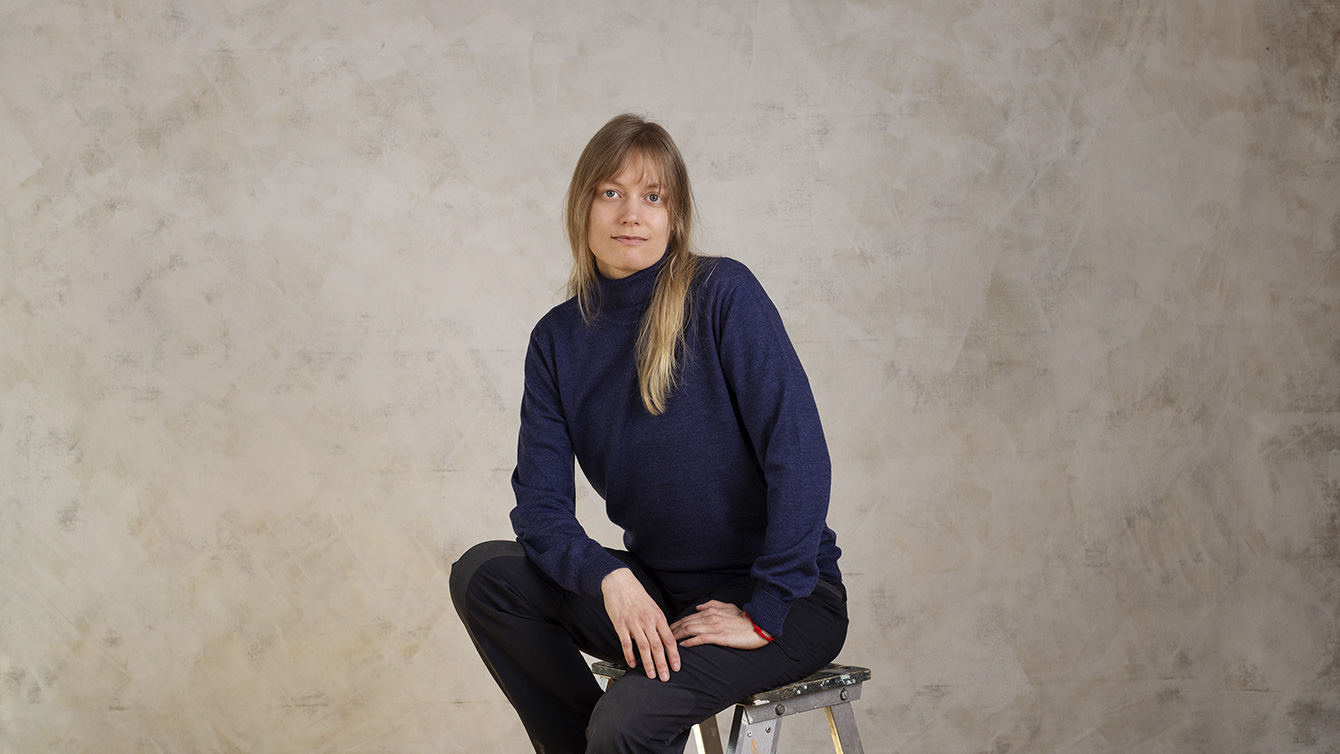
Tell us more about your project. How did you gravitate to this subject, and what is the work about?
I’ve been making my way to Svalbard ever since I was five years old. Back then, my family used to travel around Lapland without any specific destination in mind, but always heading north. For me, Svalbard does not represent a specific place, but rather the force of a magnetic field that draws the compass needle towards it: an arctic region where the Earth’s tilting central axis pierces its surface.
To me, the North represents the landscape of my childhood, where I could touch a winter’s night and its glittering crystals of snow with an outstretched hand and where stars, planets and comets become part of the neighbourhood – like any hypermarket.
I feel that there is not much left of these familiar winter nights back home at the Arctic Circle, as climate change is rapidly destroying the North. I need winter. That’s why I went to Svalbard.
People have gone North to seek their own limits, the edge of the world, a window into space, natural resources and spiritual meaning. In my work, I wish to explore these aspects from a personal perspective. I want to look for answers to questions I don’t yet know to ask.
My hope is that by preserving my Svalbard film into an emotional reserve, it could in some small way help slow down the natural disaster that is coming as a consequence of climate change.
How are you approaching the visual world of the film you’re currently developing?
The North is made up of magical elements. I grew up surrounded by Arctic imagery. I have been influenced by my father’s strange and partly abstract photographs of winter nights in Lapland. I see the landscapes as if through a telescope, and I draw my inspiration from the astronomy magazine Tähdet ja Avaruus.
For me, the materiality of the North emerges from the everyday details, many of which I experience as bodily sensations. These include things such as the wet colour palette of snowy slush or the water vapour rising from a swimming pool into the night.
In winter, the plant and animal species of Svalbard are mostly in hiding. I’m not chasing after polar bears on the melting ice floes; instead, I try to capture the feeling of the North and the vastness that surrounds my camera. Millions of years are on display in the barren landscape of the Svalbard archipelago, and signs of extractivism, such as coal mines, have emerged alongside them.
What can you say with a feature film that you couldn’t say in other forms?
It is said that film is a form of art that brings together several art forms. Through my works, I have attempted to convey something about myself and the world I live in, about forces of nature and the longing that they awaken in me.
On the other hand, saying anything about the Arctic can sometimes drive me crazy. The silent eternities of the universe, expeditions into modern society and mythology become interwoven. The feature-length format provides space to explore these elements floating about around us. Maybe if they are given enough time, they can take the viewer deeper into themselves.
What plans do you have for your career as a filmmaker? How do you think Kehittämö can help you get closer to your goals?
If I don’t live forever, I’ll have roughly 0–60 years to explore my ideas and my questions about the universe. It is both a long and a short time on a changing planet, where capturing a moment always feels like you are just a little bit too late. Perhaps making films, asking questions and communicating about them are simply ways of being alive. I want to continue experiencing the atmospheres of the modern world.
Perhaps ‘fun’ isn’t quite the right word, but I think it’s more fun to do this together with my mentor and with AVEK’s support. If you’re sailing on a sea of questions, it’s nice to bring along someone who’s sailed before.
Interviewer: Ella Jaakkola
Photo: Riitta Supperi